

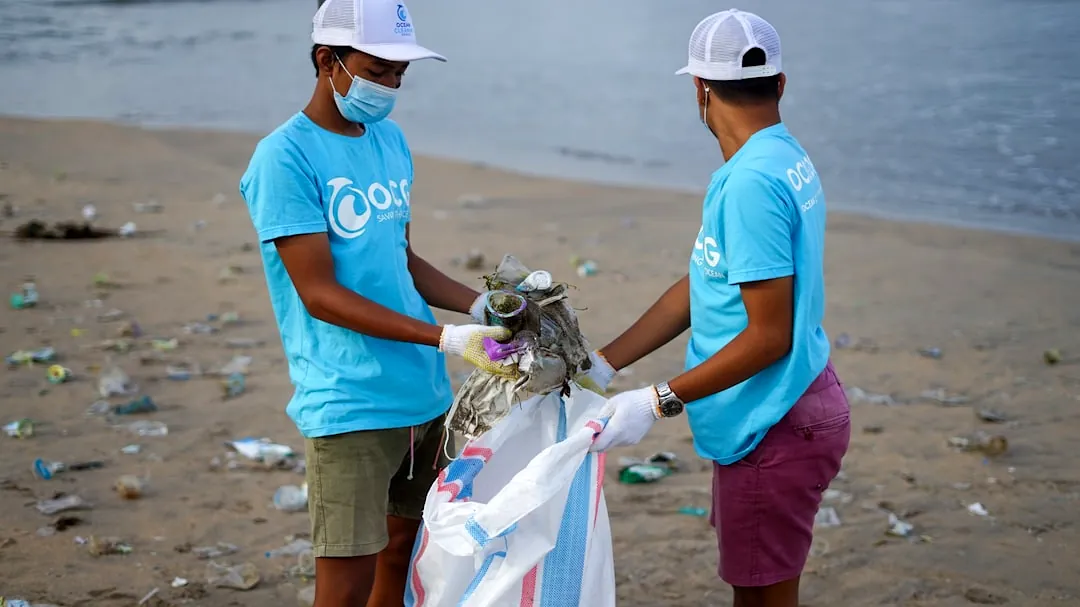
The headline finding is stark: researchers now estimate about 27 million tons of nanoplastics — particles smaller than one micrometer — float in the North Atlantic, a quantity comparable to larger visible debris, and current technology cannot remove them. That reality forces a shift from cleanup-heavy responses toward prevention, tighter waste controls, and targeted monitoring where land-based inputs are strongest.
How scientists tracked the “missing” plastic
A team led by Utrecht University published these results in Nature after sampling 12 North Atlantic sites at different depths and applying advanced mass spectrometry to detect polymer fragments too small for nets and visual surveys. The study detected PET, polystyrene (PS), and PVC among the smallest particles and reported coastal concentrations about 1.5 times higher than open-ocean sites, pointing to rivers, runoff and atmospheric deposition as major sources.
Not all plastics showed up in the tiniest fraction: polyethylene and polypropylene — common in packaging — were absent in the smallest size class, a pattern researchers attribute to analytical limits or masking by organic matter rather than proof of absence. That detection gap is an explicit call for better methods before we assume a complete inventory of microscopic pollution.
Why standard cleanup tools can’t fix this problem
Particles under one micrometer pass through fine sieves, escape booms and mesh-based skimming systems; they are functionally dissolved at scales current cleanup tech handles, so mechanical removal is effectively impossible across the open ocean. Nanoplastics’ ability to penetrate biological membranes — they have been found in marine food webs and even in human brain tissue — also means removal would require filtering water at biological or cellular scales, a task no existing environmental program can perform at ocean scale.
Comparing options: visible-debris removal reduces wildlife entanglement and shoreline blight and remains worthwhile at beaches and for fishing gear, but it does little for the dominant, microscopic fraction identified by the Utrecht team. The study also links the plastic lifecycle to greenhouse gas emissions and potential disruptions of carbon cycling, so addressing nanoplastics intersects with climate mitigation. With global plastic production projected to roughly triple by 2060, prevention becomes the only scalable lever — tightening inputs at source, improving waste capture on land, and slowing fragmentation before plastics reach one-micron scales.
Who should act, and what signals indicate progress or failure
Not every actor has the same leverage. Individuals can reduce single-use items and favor durable materials; municipalities control wastewater and stormwater capture that directly cuts coastal nanoplastic inputs; manufacturers can change polymer choices and product design to limit fragmentation; regulators set collection, extended producer responsibility, and emissions rules. Success and failure are measurable but require specific indicators: coastal concentration drops, lower micro/nano counts in effluent, and reduced particle fluxes from rivers.
| Actor | Practical first step | Short-term checkpoint |
|---|---|---|
| Households | Cut single-use PET/PS items, favor refillables | Lower household plastic waste to local collection by X% (jurisdictional target) |
| Cities & utilities | Upgrade stormwater filters, trap road runoff, and monitor river outflows | Measured drop in river-borne nano/micro counts at outfalls |
| Manufacturers | Redesign to reduce fragmentation and use polymers less likely to form persistent nanofragments | Product stewardship programs and documented reduced fragmentation in lab aging tests |
| Policymakers | Set EPR, restrict high-risk uses, fund monitoring in coastal basins | Regulatory targets adopted and funded baseline monitoring campaigns |
What to watch next: research milestones and regulatory checkpoints
Follow-up studies replicating the Utrecht results in other ocean basins are the immediate scientific checkpoint: if the North Atlantic pattern holds in the Pacific and Southern oceans, the global scale of the microscopic problem becomes clearer. Researchers also need better assays to detect polyethylene and polypropylene at sub-micrometer sizes to close the current inventory gaps noted in the Nature paper.
On the policy side, the useful near-term indicators are concrete: adoption of extended producer responsibility rules, investments in wastewater and stormwater capture for coastal municipalities, and publicly available monitoring data on nanoplastic concentrations in rivers and coastal zones. Absent these moves, increased plastic production projected through mid-century will almost certainly raise nanoplastic loads rather than reduce them.
Short Q&A
Can I avoid nanoplastics in my diet? Not entirely — nanoplastics have been detected in seafood and human tissues — but reducing consumption of single-use packaged seafood, favoring whole foods, and supporting fisheries with good waste practices lower personal exposure vectors.
Are beach cleanups pointless? No. Cleanups remove visible hazards and reduce future fragmentation of large debris; they are complementary to prevention but do not address the dominant nanoplastic fraction now identified in the North Atlantic.
When will we know the health risks? Clear, quantitative links between environmental nanoplastic levels and specific human health outcomes will take more targeted toxicology and epidemiology; expect incremental results as labs develop consistent detection methods and larger population studies follow.